Did You Know?
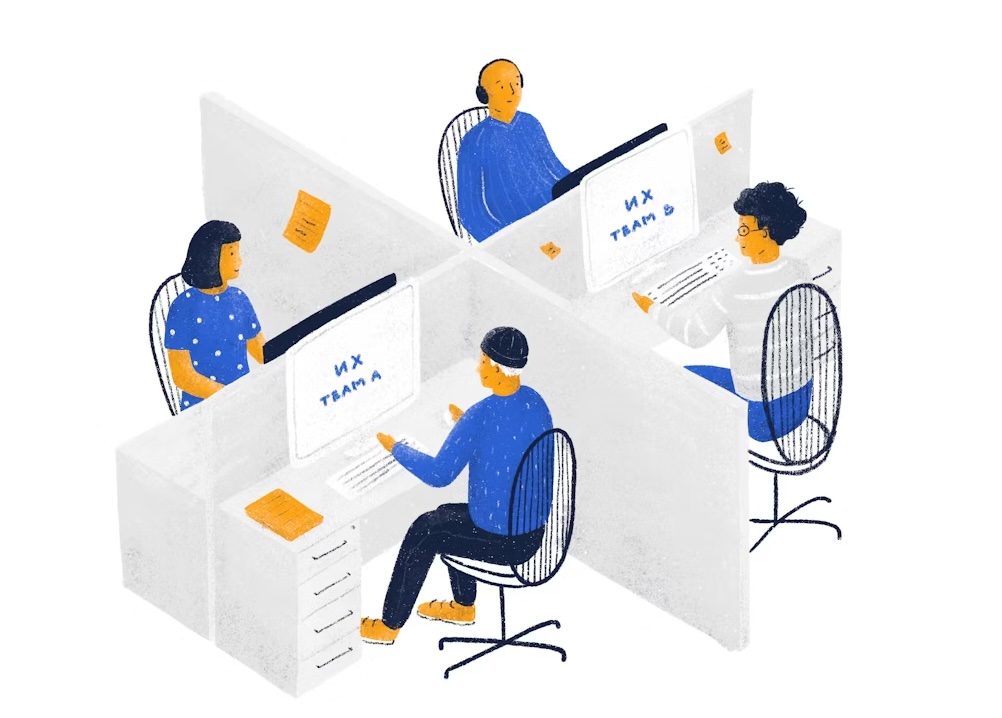
Did you know that companies investing in UX design see an average ROI of $100 for every $1 spent? Yet, 55% of businesses still don’t conduct UX testing, leading to lost revenue and frustrated users.
UX isn’t just about aesthetics—it’s a strategic function that blends research, design, psychology, and data-driven decision-making. The challenge? Structuring a UX team that fosters collaboration, efficiency, and innovation.
In this guide, we’ll break down:
- The core roles every UX team needs
- Team structures and how to choose the right one
- Scaling strategies for growing organizations
- Best practices to improve efficiency and impact
Let’s dive in.
1. The Minimum Viable UX Team: Where to Start?
A strong UX foundation requires expertise in three core areas:
- Research – Understanding user behavior, needs, and pain points.
- User Experience (UX) Design – Creating seamless, logical interactions.
- User Interface (UI) Design – Enhancing engagement through visual design.
1.1 Research: The Foundation of UX
Studies show that 70% of digital transformation projects fail due to a lack of user understanding. A UX team must include research expertise, whether through a dedicated UX researcher or a multidisciplinary team member with research skills.
Best Practices:
- Blend qualitative & quantitative research – Use user interviews, heatmaps, A/B testing, and analytics.
- Start early – Fixing UX issues post-launch costs 100x more than during prototyping.
- Make research ongoing – User needs evolve, so research should be continuous.
1.2 UX Design: More Than Just Wireframes
A 67% user abandonment rate is attributed to poor usability. UX designers transform research into intuitive experiences through wireframing, prototyping, usability testing, and iteration.
Best Practices:
- Prioritize usability & accessibility – Follow WCAG standards.
- Design with data – Every iteration should be informed by user testing & analytics.
- Speed matters – Users form an impression in 0.05 seconds.
1.3 UI Design: The Visual Experience
UI design ensures a product’s look and feel align with usability. However, UI often extends from UX rather than being a separate function.
Best Practices:
- Leverage visual hierarchy – Users scan screens in F-patterns or Z-patterns.
- Ensure brand consistency – A strong UI reinforces trust.
- Use microinteractions – Animations enhance perceived speed and engagement.
👉 Minimum Viable UX Team Recommendation: At a basic level, a UX team should consist of a Product Designer (UX/UI) + UX Researcher. As the team scales, roles should become more specialized.
2. Scaling the UX Team: Key Roles & Specializations
As UX teams grow, responsibilities should be distributed strategically. Here’s how common UX roles evolve:
2.1 UX Researcher: The Data-Driven Strategist
80% of companies that use customer insights outperform their competitors, yet 42% of organizations lack dedicated UX researchers.
Key Responsibilities:
- Conducts user interviews, surveys, and usability tests.
- Analyzes behavioral data & competitor research.
- Translates insights into actionable recommendations.
2.2 UX Designer: The Experience Architect
Key Responsibilities:
- Develops wireframes, prototypes, and user flows.
- Conducts usability testing & accessibility checks.
- Ensures seamless, frictionless interactions.
🚀 Best Practice: Test early, test often – Fixing UX issues in prototyping is 10x cheaper than post-launch.
2.3 UI Designer: The Visual Storyteller
Key Responsibilities:
- Designs high-fidelity interfaces.
- Ensures brand consistency & usability.
- Works with developers to implement designs effectively.
👉 Reality Check: Many companies merge UX & UI roles into Product Designers, but larger teams benefit from dedicated UI specialists.
2.4 UX Writer: The Voice of the Interface
95% of UX is text-based, meaning poorly written microcopy can lead to confusion and high drop-off rates.
Key Responsibilities:
- Writes microcopy for buttons, error messages, and onboarding flows.
- Aligns content strategy with UX best practices.
- Enhances clarity & reduces friction in user interactions.
2.5 Information Architect: The Digital Librarian
A well-structured UX experience prevents confusion and drop-offs. Amazon, for example, heavily relies on information architecture (IA) to organize massive amounts of data.
Key Responsibilities:
- Structures content & navigation.
- Develops sitemaps & taxonomies.
- Optimizes search & filtering functionalities.
3. Choosing the Right UX Team Structure
3.1 Centralized UX Team
Best for: Small to mid-sized organizations
- Ensures consistency across products.
- Encourages knowledge sharing & specialization.
- Facilitates strong UX governance.
📊 Example: A SaaS company managing multiple tools (CRM, project management) uses a centralized UX team to ensure uniformity across products.
3.2 Decentralized (Embedded) UX Team
Best for: Large organizations with multiple product lines
- Designers are fully embedded in product teams.
- Faster decision-making & iteration cycles.
- Closer alignment with business goals.
📊 Example: Amazon embeds UX designers within specific product teams (e.g., checkout, Alexa, Prime).
3.3 Mixed UX Team
Best for: Scaling organizations needing flexibility
- Combines centralized governance with embedded UX experts.
- Balances consistency & agility.
- Supports cross-functional collaboration.
📊 Example: PayPal centralizes research & accessibility experts while embedding product designers in specific teams.
4. Scaling & Evolving UX Teams
As organizations grow, UX teams must adapt to evolving needs.
4.1 Scaling Challenges & Solutions
- Maintaining consistency? → Establish a Design System (Figma, Storybook).
- Communication silos? → Implement cross-team UX syncs.
- Generalists vs. Specialists? → Use a hybrid hiring approach.
4.2 Emerging UX Roles
- Accessibility Specialists – Ensure WCAG & ADA compliance.
- UX Operations Managers – Optimize design processes.
- Ethical Designers – Focus on AI bias, privacy & trust.
📊 Real-World UX Evolution:
- Spotify: Uses Data Scientists to refine personalization.
- Netflix: Employs Cultural UX Researchers for global market adaptation.
5. Final Thoughts: UX Is a Competitive Advantage
Companies investing in UX enjoy:
✔️ Lower development costs
✔️ Higher conversions & retention
✔️ Better customer satisfaction
✅ Small teams? Start with a Product Designer + UX Researcher.
✅ Scaling teams? Specialize with dedicated UX, UI & research roles.
✅ Enterprise teams? Balance centralized oversight with embedded UX professionals.
💡 Need help optimizing your UX team? Book a free consultation today! 🚀
 THINK WITH ALEC
Leave a comment