
In today’s digital marketplace, stagnation is a choice—and a costly one. While some organizations push forward with platform modernization and agile architecture, many others stall their progress, maintaining outdated, monolithic systems that buckle under modern expectations. The result? A widening gap between industry leaders and laggards, where catching up isn’t just expensive—it may be impossible.

Why Modernization Matters
Consumers demand seamless, personalized, omnichannel experiences. If your platform can’t support these demands, your competitors will. According to Gartner, by 2026, 70% of B2C and B2B companies will move away from monolithic applications in favor of composable commerce architectures to improve time-to-market and agility.
Composable commerce—where you assemble best-of-breed components for search, checkout, CMS, payments, and more—allows businesses to stay nimble. This architecture gives digital leaders the flexibility to innovate quickly, scale efficiently, and meet evolving customer expectations.
What’s at Stake: The Hidden Costs of Staying Still
Not modernizing comes with significant risks that compound over time:
🔴 Operational Inefficiency
Legacy platforms require heavy maintenance, manual workarounds, and patchwork integrations. This increases technical debt and diverts IT resources from growth-driving initiatives.
Forrester reports that organizations spend up to 70% of their IT budgets maintaining legacy systems.
🔴 Slow Speed to Market
Releasing new features, running A/B tests, or entering new markets becomes a slow, risky endeavor. By the time you respond to market shifts, agile competitors have already launched, tested, and iterated.
🔴 Customer Churn
Today’s consumers expect fast, frictionless digital experiences. A slow, buggy, or impersonal platform results in lost trust—and lost customers.
95% of customers say a bad user experience ruins their brand impression, and 32% will walk away after a single bad experience (PwC).
🔴 Security Risks
Older platforms are more vulnerable to security breaches and compliance issues. Modern platforms come with built-in security patches, better data governance, and integration support for evolving regulations (like GDPR, CCPA).
🔴 Talent Drain
Modern developers don’t want to work on legacy tech. You risk losing top talent who would rather build with APIs, microservices, and cloud-native tools.
The Business Case for Composable E-Commerce
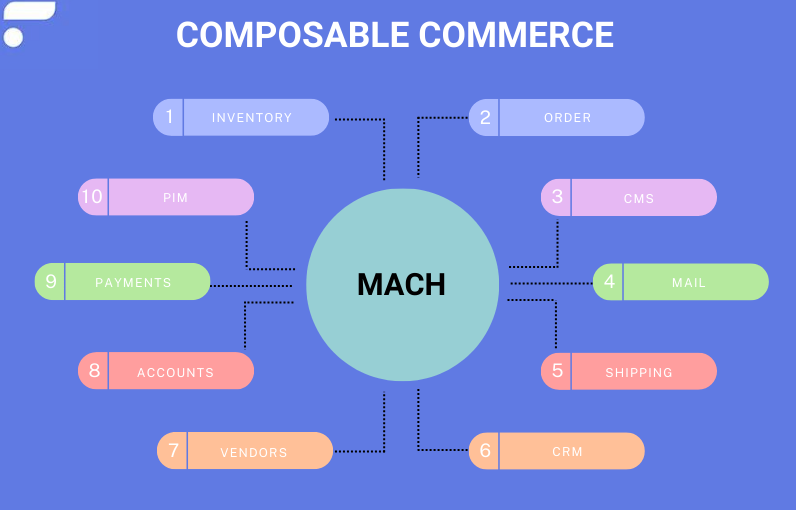
If digital transformation once felt optional, today it’s a competitive necessity. Here’s why:
- Faster Innovation: Launch new features without rebuilding the whole site.
- Scalability: Handle spikes in demand with cloud-native infrastructure.
- Agility: Test new business models (subscriptions, DTC, B2B2C) without tech barriers.
- Future-Proofing: Add or swap components as your business evolves.
According to a report by Elastic Path, companies that adopt composable commerce experience a 60–80% reduction in time to market for new features and a 30% increase in developer productivity.
Real-World Impacts: Winners vs. Watchers
- Nike has built a modular digital stack enabling it to roll out new features in days, not months.
- Amazon reinvents its customer journey constantly, thanks to its decoupled services and flexible backend.
- Traditional retailers who didn’t adapt during COVID-19 saw devastating impacts—store closures, inventory chaos, and massive customer churn.
Meanwhile, digitally native brands, built from the start with headless or composable architecture (like Glossier or Allbirds), continue to grow because they can pivot quickly and deliver consistently excellent user experiences.
Key Signals You’re Falling Behind
If you check off more than two of these, modernization may already be overdue:
- Your marketing team needs IT support for every campaign.
- Launching a new product or entering a new region takes months.
- You can’t easily integrate modern tools (like AI, personalization engines, or chatbots).
- Page speed is slow or bounce rates are climbing.
- You’re losing customers to faster, sleeker competitors.
Moving Forward: A Strategic Roadmap
- Assess Your Current Stack
- Audit pain points: speed, usability, integrations, developer workflow.
- Start Small
- Don’t try to “rip and replace” everything. Begin with key areas like CMS, search, or checkout using MACH principles (Microservices, API-first, Cloud-native, Headless).
- Collaborate Cross-Functionally
- Involve marketing, product, IT, and finance early to build a unified modernization plan.
- Choose the Right Partners
- Consider vendors that align with your long-term vision. Look for flexibility, proven support, and a clear roadmap.
- Plan for Change Management
- Budget for retraining, onboarding, and internal advocacy. Technology is only part of the transformation.
Final Thought: Doing Nothing Is a Choice—A Risky One
Inaction isn’t a neutral decision. Every year your business stays tethered to outdated systems, competitors with composable, scalable tech edge further ahead. As the industry evolves, the leap you need to make grows exponentially larger and costlier.
💡 Modernizing now gives you optionality, adaptability, and a competitive edge. Doing nothing? That just ensures you’ll be playing catch-up—if you’re lucky.
Related Artciles
https://www.linkedin.com/pulse/cost-legacy-systems-how-outdated-holds-companies-back-andre-occec/
https://www.linkedin.com/pulse/legacy-systems-do-help-hamper-digital-transformation-journey-rizk/
 THINK WITH ALEC
Leave a comment