
A leader’s guide to mastering AI adoption using Gartner’s AI Maturity and Roadmap framework
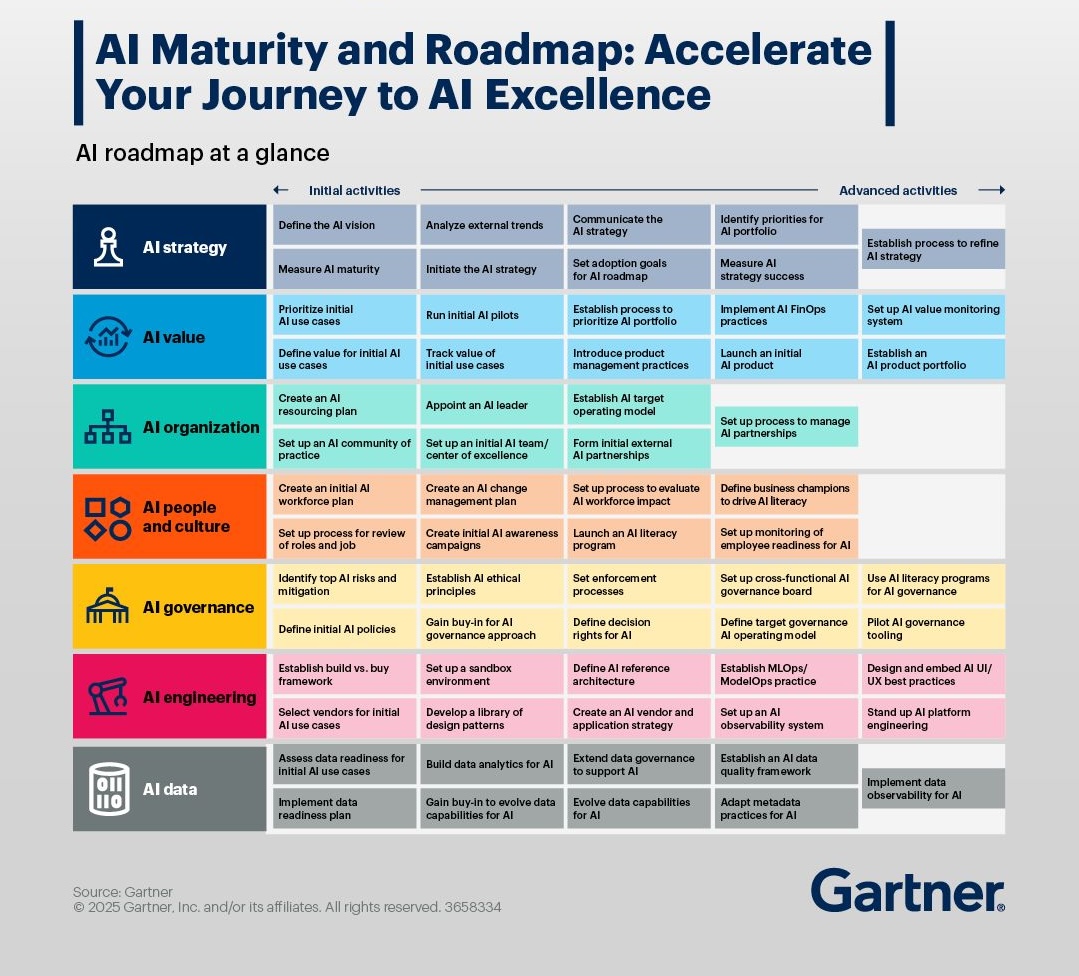
Introduction: Why AI Strategy Is the New Business Strategy
- Briefly describe the hype vs. reality around AI in 2025.
- Introduce Gartner’s AI roadmap as a practical tool to cut through the noise.
- Promise the reader a walkthrough of each pillar with concrete, actionable steps for business planning.
Step 1: Build a Strong AI Strategy Foundation
Headline: “Start With the Why: Align AI With Business Objectives”
- Define your organization’s AI vision.
- Measure current AI maturity; don’t guess and make too many assumptions.
- Analyze industry trends to inform strategic direction.
- Set adoption goals, KPIs, and governance guardrails.
- Leader Tip: Involve both business and technical leadership in vision creation.
Step 2: Prioritize Use Cases That Deliver Real Value
“No More AI Experiments, Build for Impact”
- Identify initial AI use cases with measurable business value.
- Run pilots, but prioritize scalability.
- Track and optimize value across the product lifecycle.
- Establish AI FinOps to monitor cost-benefit and ROI.
- Leader Tip: Tie AI use cases to revenue, efficiency, or customer experience metrics.
Step 3: Organize for Success With the Right Talent and Teams
“AI Isn’t Plug-and-Play. It Needs People and Structure”
- Create a formal AI resourcing plan.
- Appoint an AI leader or head of AI strategy.
- Stand up a center of excellence or cross-functional task force.
- Build external partnerships when internal capabilities fall short.
- Leader Tip: Revisit org design to embed AI capabilities across teams.
Step 4: Invest in People, Culture, and Change Management
“Culture Eats AI Strategy for Breakfast”
- Create an AI workforce plan: reskill, upskill, and reorganize roles.
- Launch AI awareness and literacy programs across all departments.
- Define business champions and track readiness.
- Leader Tip: Don’t wait until AI tools are live; train and engage your people early.
Step 5: Govern with Principles, Not Just Policies
“Trust and Accountability Must Scale With AI”
- Identify and mitigate AI risks (bias, transparency, explainability).
- Create ethical AI principles and policies.
- Stand up a cross-functional AI governance board.
- Define data ownership, consent, and decision rights.
- Leader Tip: Make governance collaborative, not restrictive.
Step 6: Get Your Data and Engineering Stack AI-Ready
“No Data, No AI. Period.”
- Build data readiness: quality, structure, and availability.
- Extend data capabilities: metadata, observability, data analytics.
- Develop scalable MLOps and platform engineering.
- Evaluate vendor and platform infrastructure.
- Leader Tip: Invest early in data ops and architecture; it’s your AI fuel source.
Conclusion: Where to Start and What Comes Next
- Encourage readers to assess where they currently fall across the 6 pillars.
- Link to Gartner’s chart (if license or embedding allows) or summarize visually.
- Recommend starting with 1–2 areas (usually strategy and data).
- Close with a call to action: build a 6–12 month AI roadmap with cross-functional input.
 THINK WITH ALEC
Leave a comment