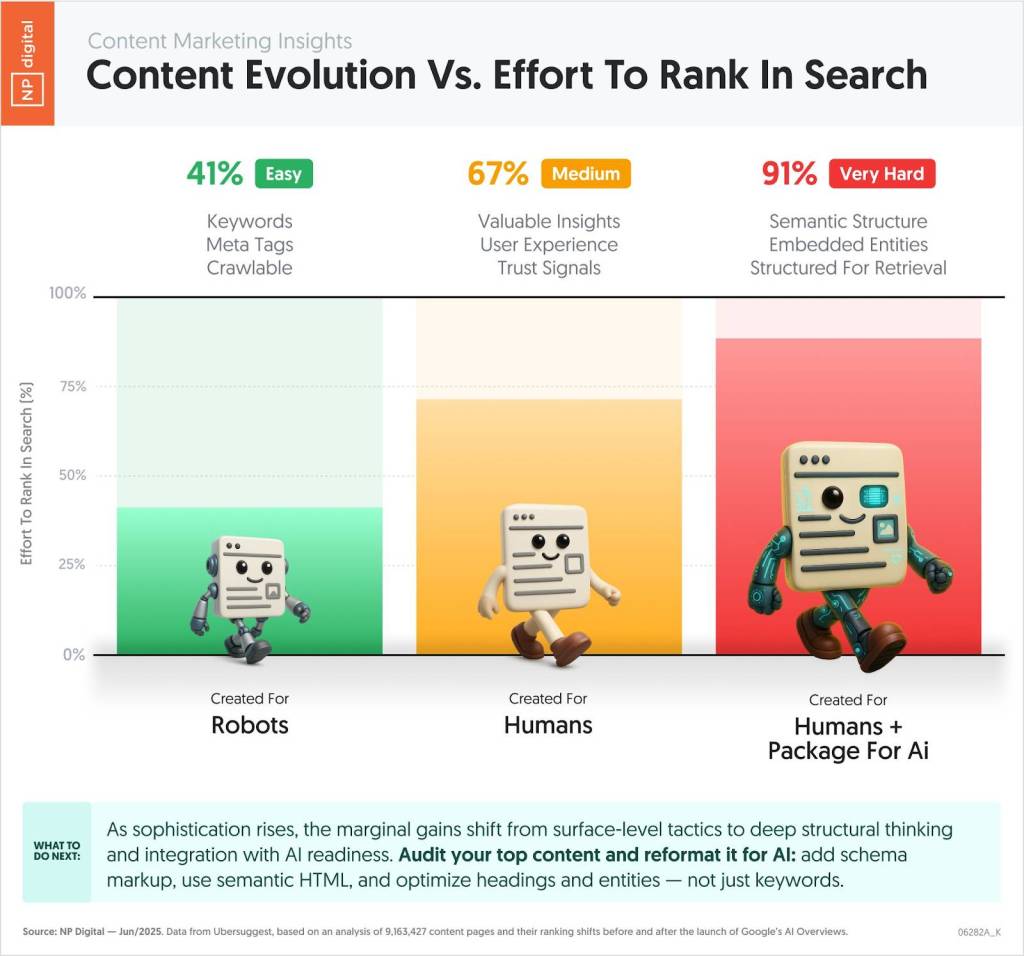
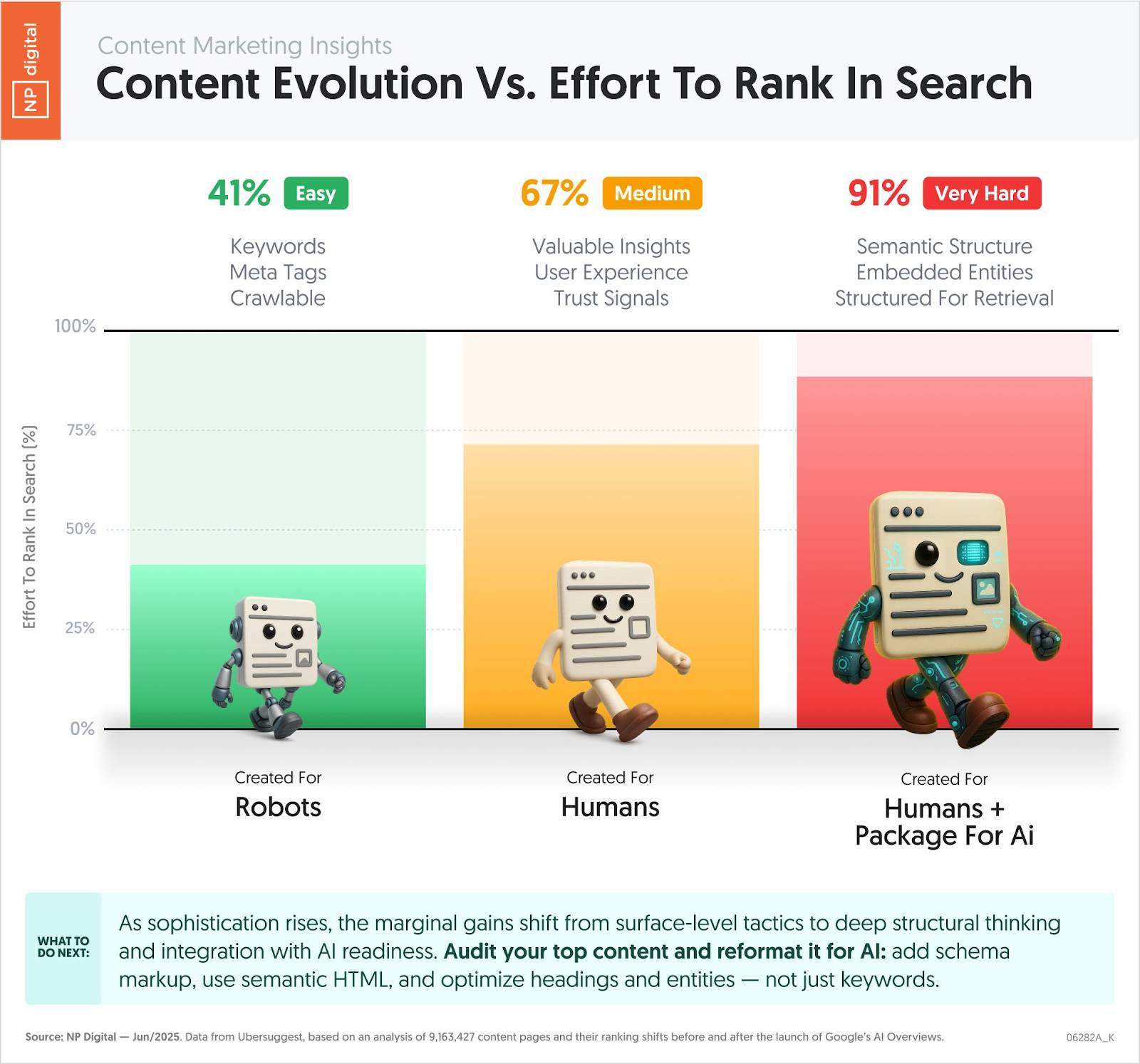
NP Digital’s latest visual on content evolution presents a compelling reality. Ranking in search has never been harder. What started as keyword-stuffed pages designed for robots has transformed into sophisticated, structured content meant to serve both humans and AI systems. The effort to rank has jumped from 41 percent (for basic keyword-based content) to a staggering 91 percent when optimized for semantic structure and retrieval.
The big question is: how can email marketers apply this learning to improve email performance and stay ahead?
Content Evolution at a Glance
Three Stages of Content Development:
- Stage 1: Created for Robots (41 percent effort)
- Relies on keywords, meta tags, crawlability
- Stage 2: Created for Humans (67 percent effort)
- Prioritizes value, experience, and trust signals
- Stage 3: Created for Humans and Packaged for AI (91 percent effort)
- Built for semantic structure, embedded entities, and retrieval
This evolution isn’t just an SEO challenge. It is a roadmap email marketers can follow to build better-performing campaigns.
1. Rethink Your Email Content Strategy
Modern emails are no longer just about catchy subject lines. To perform, your email content must be:
- Personalized
- Behaviorally triggered
- Structurally sound
- Ready for AI parsing
Recommendation: Treat every email like a microsite. Focus on structure, data layering, and responsiveness.
2. Audit and Optimize Email Structure
Just as Google rewards schema-rich content, inbox providers like Gmail and Apple Mail prioritize structured, well-coded emails.

Best Practices:
- Use clean HTML templates
- Include accessible elements (alt text, logical hierarchy)
- Add dynamic blocks for promotions, product feeds, and timers
- Avoid unnecessary inline styling or deprecated tags
3. Shift From Generic Blasts to Smart Segmentation
Relevance drives performance. That starts with segmentation based on:
- Browsing or purchase behavior
- Lifecycle stage
- Email engagement patterns
Smart tactics include:
- Triggered flows for cart abandonment, product reviews, and win-backs
- Dynamic content blocks that update per user segment
- Real-time behavioral tracking to adjust journeys
4. Create Emails Built for Discovery
Just like search content must be “retrievable,” your emails should be built to be:
- Easily categorized by smart inboxes
- Highly relevant to reader intent
- Enriched with metadata and signals
Email strategies to implement:
- Include personalized product recommendations
- Use semantic copy and tag important content sections
- Test different formats for better deliverability and discovery
5. Use AI to Drive Real-Time Performance

Email tools today offer embedded AI capabilities that can:
- Predict optimal send times
- Personalize subject lines and content blocks
- Adapt journeys based on performance metrics
Consider platforms like:
- Klaviyo for predictive automation
- Salesforce Marketing Cloud for AI-driven journeys
- Braze or Customer.io for behavior-based messaging
6. Treat Email as a Feedback Loop, Not a One-Way Street

Top-performing email programs learn and evolve. They don’t rely solely on A/B testing.
Instead:
- Leverage machine learning to identify patterns
- Apply multivariate testing for faster insights
- Use AI to auto-adjust flows, subject lines, and content per user
7. Align Email and SEO Tactics
Many best practices now overlap. For example:
| SEO Practice | Email Application |
|---|---|
| Structured content and headings | Modular, scannable emails |
| Schema markup | Product cards, review widgets, countdowns |
| Semantics and retrieval readiness | Personalization, clean HTML, behavioral flows |
8. Final Takeaways
To future-proof your email strategy, align with the same principles used to rank top content today. That means:
- Personalizing deeply and dynamically
- Structuring emails for readability and AI parsing
- Treating every send as a learning opportunity
- Moving from reactive to predictive
What to Do Next
- Audit your current emails: Are they structured and dynamic?
- Clean your code: Strip outdated elements, make it mobile and AI-friendly
- Test smarter: Move beyond simple A/B testing
- Leverage automation: Use behavioral and predictive tools
- Align with SEO goals: Treat content, structure, and insights as one system
 THINK WITH ALEC
Leave a comment